Habits
It Takes 66 Days, Not 21
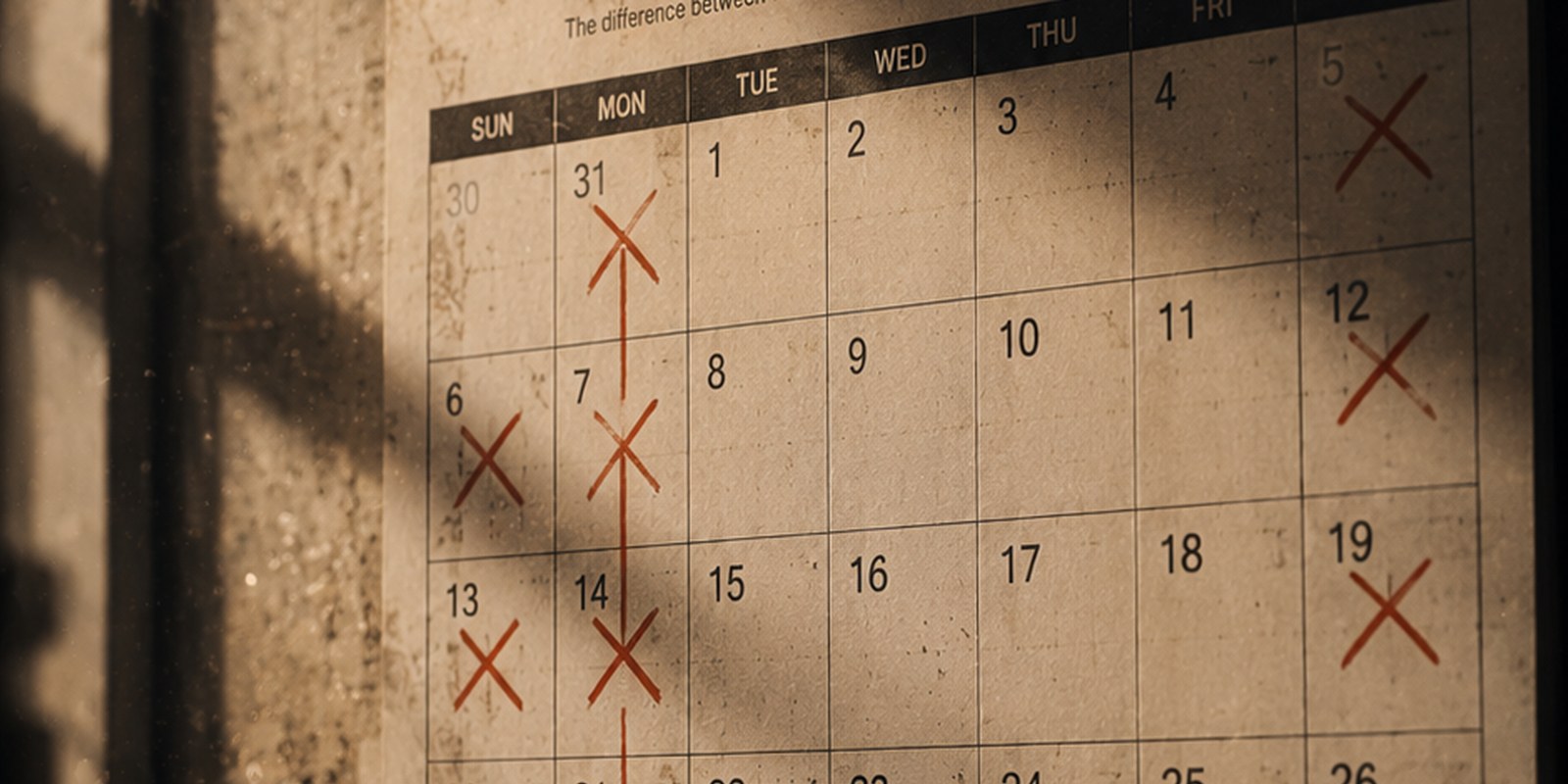
You have heard that it takes 21 days to build a habit. You have probably also quit something around day 25 or day 30, felt the resistance still fully intact, and concluded that you were the exception — that the rule works for other people and does not work for you.
The rule was never a rule. It was a sentence in a book about plastic surgery, and it has been quietly ruining people's confidence for sixty years.
Where the 21 days came from
In 1960 a cosmetic surgeon named Maxwell Maltz published Psycho-Cybernetics. In it he noted an observation from his practice: it seemed to take his patients a minimum of about 21 days to get used to a changed face, and amputees roughly the same span before the sensation of a phantom limb faded.
Read that carefully. It was an informal clinical observation. It was about adjusting to a change that had already happened to you, not about building a new voluntary behaviour. And Maltz wrote "a minimum of about" — a floor, with no ceiling attached.
The self-help industry dropped the "minimum," dropped the "about," dropped the surgery, and kept the number. Twenty-one days. Three tidy weeks. It fits on a book cover and it sells a challenge, so it spread everywhere and stopped being questioned.
What was actually measured
The number people should be quoting comes from a study led by Phillippa Lally at University College London, published in the European Journal of Social Psychology. Participants each picked one simple daily behaviour — a glass of water with lunch, a short run before dinner — and rated how automatic it felt, day after day, for twelve weeks.
The automaticity curve was the shape you would expect: steep at first, then flattening as the behaviour became second nature. The median time to reach that plateau was about 66 days.
The more useful finding is the spread. Across individuals and behaviours it ranged from roughly 18 days to 254 days. Not everyone is a 66. A glass of water is not a 5 a.m. gym session. Some people, on some habits, are genuinely looking at eight months.
Sixty-six days is a median, not a deadline. The honest headline is not "it takes 66 days." It is "it takes far longer than anyone told you, and the number is different for everyone."
Why the wrong number does real damage
If you believe the deadline is 21 days, then day 30 is not a data point — it is a verdict. You are past the line. The habit was supposed to have set. It has not. There is only one conclusion available: something is wrong with you.
So you stop. And the thing you stopped was, on the real curve, roughly at the halfway point. You quit in the exact stretch where the work is genuinely happening and none of it is visible yet.
Then the damage compounds, because you did not just lose the habit. You added another entry to the private file of evidence that you cannot stick to things. Start the next one carrying that file and you begin with less conviction than you had the time before.
None of that came from a lack of discipline. All of it came from a made-up number.
The finding that matters most
Buried in the same research is the part almost nobody quotes: missing a single day did not meaningfully damage the process. One skipped day did not reset the curve. Automaticity continued to build.
This quietly demolishes the streak-or-nothing model that most habit apps are built on. The all-or-nothing framing turns one missed Tuesday into a total collapse — not because the miss mattered, but because the framing said it did.
What actually appears to hurt is the abandonment that follows the miss. A skipped day is noise. Three skipped weeks, because a skipped day was read as proof of failure, is the thing that ends it.
What to do with this
- Set the horizon at two to three months, not three weeks. If it still feels effortful at day 40, that is the curve behaving normally. Nothing has gone wrong.
- Judge by effort, not by ease. "Did I do it" is measurable today. "Does it feel automatic yet" is a slow signal and a terrible day-to-day metric.
- Never miss twice. One miss is inside the tolerance the data shows. The rule that protects you is not perfection — it is refusing to let one become two.
- Make it small enough to survive a bad week. The version of the habit that survives your worst week is the version that actually reaches 66 days. Ambition that only works on good days never gets there.
- Go back to the one you dropped. If you abandoned something at day 30 believing you had failed, you did not fail. You stopped early, on the strength of a misquoted surgeon.
Sixty-six days. Sometimes many more. It is a slower, less marketable, considerably more forgiving picture than the one you were sold — and it puts almost every habit you have ever "failed" back within reach.
You did not fail at day thirty. You were still early. Go back.
Quiet Progress posts one short reminder like this every day — no hustle, no shouting, just the small stuff that actually compounds.